
Rising Strong: Former Resident Reflects on Leathermarket JMB Impact
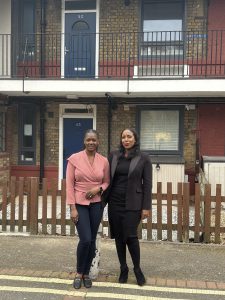
Hannah Awonuga — In Her Own Words
Coming back to Leathermarket JMB is surreal and deeply nostalgic for me, because this place was the springboard for an entirely new life.
I moved onto the Elim estate in 2007. I was 17. It was my first flat—secured through the council—and I remember coming up to view it with my dad. Things were difficult at home; my relationship with my mum had broken down and I’d been living independently since I was 15. That meant hostels, assisted living and, eventually, a small, shared place on Walworth Road. In those settings you’re constantly being assessed—can you cook, can you budget, can you be safe on your own? It’s a lot for a teenager.
Walking into the Elim estate, everything felt different. Quieter. Safer. I’d grown up around Bermondsey—St Michael’s, St Joseph’s, Jamaica Road—so being here felt closer to home than Walworth Road or Peckham or Brixton where life felt loud and overstimulating. Elim was a one‑bedroom flat, and for the first time, it was just me. That’s how I started my life.
I lived there for seven years. I had my first son there. Then we did a mutual exchange—one bedroom to three—still in Bermondsey. The lady we swapped with wanted to downsize; my family needed to upsize. By then I had two boys, and the move was perfect.
The estate itself felt diverse in a very natural way—Black African, white British, European—my next‑door neighbour was a Black French guy; the guy downstairs was European. People tended to keep themselves to themselves, but I felt safe. My best friend’s parents lived just behind here—we still talk today, even though we’ve both moved out of the area—and my own parents are still in Tooley Street. My eldest absolutely sees Bermondsey as home.
I’ll always be grateful for how Leathermarket JMB looked after me as a vulnerable young person. The Housing Officer was brilliant. I was even given a £500 B&Q voucher that covered my flooring and paint. That early wraparound mattered: someone saw me, saw the situation, and made sure I was set up. And then, as it should, life quietened down and the responsibility shifted to me. That part was hard. When the noise stops and the door closes, you’re alone in your home and the bills are yours. I stumbled—council tax arrears, confusion about what to pay and when. I was working, so benefits were limited; rent was manageable, but council tax and utilities felt like a maze. No one had walked me through the basics.
That’s stayed with me. I sit on the board of LandAid now, and I always say there are three fundamentals every young person needs: how to manage housing, how to manage finances, and how to become employable. If you grew up like I did—council estate, state school, low socio‑economic background—those lessons don’t arrive by default. You learn on the job. You make mistakes. I had a manager once imply I’d be better off at Tesco, not because I wasn’t capable, but because I didn’t yet know what was expected—timekeeping, uniform, unspoken professional norms. Mentors changed that for me. People who’d pull me aside and say, “Do this. Say that.” That kind of guidance saves years.
Work was my lifeline. I started as a cashier at 16—Halifax in Lewisham—and later at Barclays in Hanover Square. Exposure matters. Seeing people deposit bonuses, transfer six figures to their children for house deposits… that proximity to possibility expands your horizon. It sounds small, but if you’ve only ever known a council estate, you can’t imagine what you haven’t seen. The bank gave me routine, purpose, access.
I became a mum at 19. I went back to work when my baby was eight months old; most people around me weren’t doing that. Barclays funded my degree; at 21 I became a bank manager. I remember walking in, keys in my hand, thinking, “You’re really trusting me with this whole branch?” That responsibility accelerated my growth.
Of course, the system has its frictions. Social housing was designed with a powerful intention: offer people stability at their point of need so they can rebuild, progress and eventually step into independence—buy a home, build wealth, start a different chapter. But life isn’t tidy. There were times it cost me more to work than to stay home, once you put childcare into the equation. If you don’t have mentors, family or sheer stubborn will to push through that painful year, it’s easy to think, “This isn’t worth it.” That is not a moral failing; it’s often about environment and conditions, not will.
Along the way, I outgrew some friendships. Some people didn’t understand why my voice was changing, why my ambitions were changing. I tried to bring some along—“Come into the bank with me, I’ll help”—but not everyone wants the same things. I learned to curate my circle intentionally. Today, I have a brilliant set of friends; we share values, pace and joy. I’m not ashamed of the life I’ve built—I grafted for it—and I know not everyone will like that.
At 15, a relative drove me to Bournemouth Road in Peckham—the Southwark homeless unit—dropped me off with all my bags, and left. I was referred to temporary accommodation on Lordship Lane and told to stay 21 days before moving to assisted living. I was terrified. I checked in daily but slept on a friend’s floor. What kept me moving was the knowledge I didn’t want to go back—and then exposure and insight did the rest. The second I stepped into that bank environment, possibility took hold.
Today, I’m living my purpose. I run ILLUME, where we focus on culture governance: the intersection between board and executive governance and the lived culture people experience. You can’t execute a brilliant strategy without a healthy culture. We don’t obsess over the label “DEI”; we build systems of inclusive leadership, governance and accountability. Through a faculty model, we deliver to organisations—charities, dioceses, law firms, banks—without it all resting on me. I serve as a Non‑Executive Director at Progress Together, focusing on social mobility in financial services, and on the board of LandAid, tackling youth homelessness. I’m a governor at St Michael’s here in Bermondsey. And I run a social impact initiative called Meet My Future Self for Year 10 girls. Proximity to success matters; if a young girl hears a barrister and thinks, “Maybe I could do that,” job done. In my forties, I plan to build a hostel for young women—housing plus the three fundamentals: employability, finance, home—and to host annual conferences for Year 10 girls across schools.
People ask about the current climate. There’s noise, yes—a backlash, a relabelling—but if you look closely, organisations are still moving: strengthening protections and expectations around culture, safety and equity. Call it what you want; we’re building the same muscle—governance that treats people with dignity and drives performance.
If I could speak to my younger self, I’d say: Thank you. Thank you for walking into that bank. Thank you for choosing your focus over the noise. And to the girls I meet, I say: your beginning does not determine your end. In today’s world you’ve got the “University of YouTube,” you’ve got mentors you haven’t met yet, and you have more power than you think. Ask the questions. Seek proximity. Keep knocking.
And finally, to Leathermarket JMB: thank you. You saw a vulnerable 17‑year‑old and you helped me set up that first home—from a housing officer who treated me with care to a B&Q voucher that literally put floors under my feet. That early steadiness mattered. It gave me the quiet I needed to hear my own determination—and to build a life that now pays that care forward.